Control
PLC scan cycle and data sampling error
Before reading a PLC tag for AI, know where in the scan cycle the value was produced and which timestamp describes it.
 KutupASP Dijital
PID is the workhorse of process control. Understand what each term actually does, how the controller responds, and what tuning really means before you touch a loop.
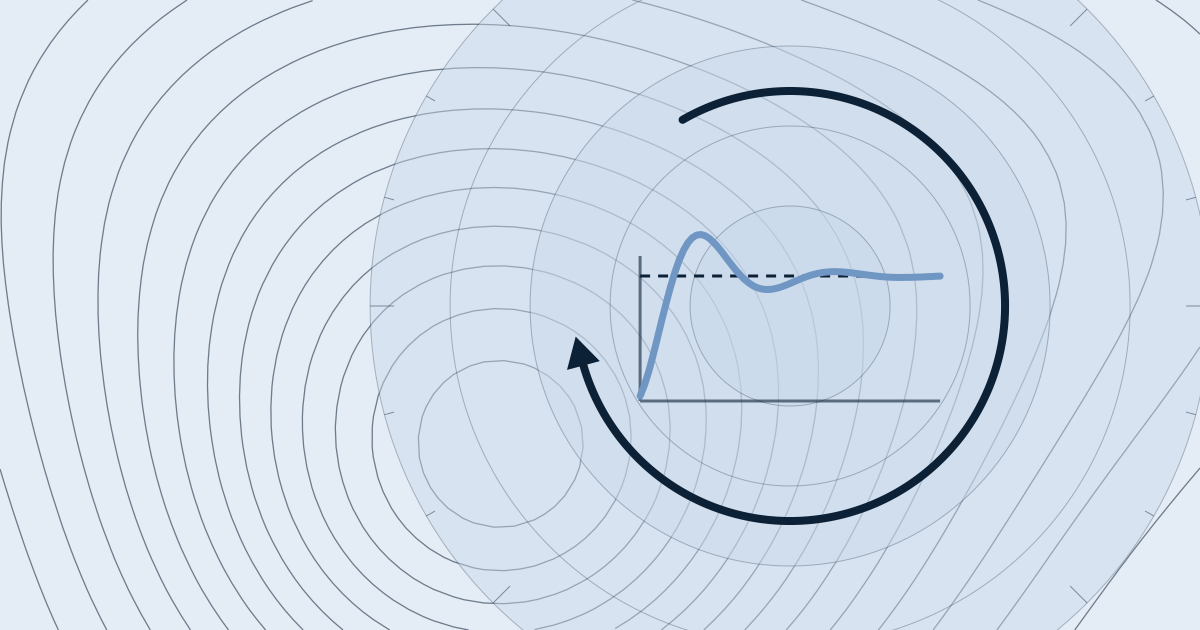
A PID controller continuously compares the process variable (PV) — measured temperature, pressure, flow, or level — with the setpoint (SP). The difference is the error. The controller computes an output (CV) that drives the final control element, typically a valve or a drive, to reduce the error.
The output is the sum of three terms: proportional, integral, and derivative. Each term responds to a different aspect of the error.
The proportional term produces an output proportional to the current error:
P = Kp × error
If the PV is 5 units below the setpoint and Kp is 2, the output moves 10 units in the corrective direction. The larger Kp, the more aggressively the controller reacts. A purely proportional controller, however, almost never lands exactly on the setpoint — at steady state it needs a persistent error to hold the valve at a non-zero position. That residual difference is called offset.
The integral term accumulates error over time:
I = Ki × ∫ error dt
It keeps "pushing" as long as an error exists, which eliminates offset. This is why every process loop needs integral action: it is the term that eventually drives the PV to the setpoint. The trade-off is that integral action can overshoot and, if too strong, cause slow oscillation or "integral windup" when the actuator saturates.
The derivative term responds to the rate of change of the error:
D = Kd × (d error / dt)
It acts like a brake: when the error is closing quickly, derivative reduces the output to prevent overshoot. In practice, derivative is used sparingly — it amplifies measurement noise, so it is often disabled on noisy or slow process variables.
Tuning is the process of choosing Kp, Ki, and Kd. There are systematic methods — Ziegler–Nichols, Cohen–Coon, and model-based tuning — but the mental model matters more than the formula:
Every loop is a compromise between speed and stability. A well-tuned loop holds setpoint with minimal oscillation; an over-tuned loop oscillates forever; an under-tuned loop responds sluggishly.
Before reading a PLC tag for AI, know where in the scan cycle the value was produced and which timestamp describes it.
Alarm floods are solved with an alarm philosophy first, not a model. AI works better on an orderly alarm list.
SCADA systems supervise and control geographically distributed assets. A practical breakdown of their five core layers and how they fit together.